Last updated 2026-08-18
TL;DR
Connecticut has no utility locator board and issues no license to individual locators. The Public Utilities Regulatory Authority (PURA) enforces the Call Before You Dig law through the CBYD one-call center. To work as a locator you need training and a job with a facility operator or contractor. No exam, no state card, no fee.
Do You Need a License for Utility Locating in Connecticut?
No. Connecticut does not license the person holding the locating wand. There is no state board that certifies utility locators, and there is no exam to pass at any state agency. The Connecticut General Statutes regulate excavation and damage prevention, but the duties fall on excavators and facility operators, not on individual locators.
Facility operators (gas, electric, telecom, water) have to locate and mark their own lines or hire qualified people to do it. Connecticut General Statutes Chapter 293 (§ 16-345 and following) sets the definitions and duties for the one-call system [1]. So the path to working as a locator here is simple: get hired by a facility operator or a private locating company that contracts with them. No state-issued card. No DMV window for this one.
This catches a lot of people off guard. Electricians need a license. Plumbers need a license. Home improvement contractors register with the state. Utility locating skips that layer entirely. The oversight lives in the one-call process and the penalties that hit after a line gets damaged.
Who Oversees Utility Locating in Connecticut?
The Public Utilities Regulatory Authority (PURA) has jurisdiction over damage prevention and enforcement in Connecticut. Its authority comes from the Call Before You Dig statute in Chapter 293 of the General Statutes [1]. PURA does not license workers. It issues fines and investigates underground facility damage.
The day-to-day runs through the state one-call center, CBYD (Call Before You Dig). CBYD is a nonprofit that takes excavation notifications and forwards them to member facility operators [5]. For a locator, CBYD is the machine that drops a ticket in your queue. You respond, you mark the lines, you report status through whatever system your employer runs.
PURA sits under DEEP after a 2021 reorganization, but the damage prevention rules did not change with the move. The agency tracks the number of hits statewide. It does not track how many locators are working, because there is nobody to license and nobody to count.
What Are the Legal Requirements for Locators in Connecticut?
With no license on the books, the rules come from federal safety law, the state one-call statute, and your employer’s own standards. Here is what the law actually asks:
- Train the people doing the work. Facility operators must make sure anyone locating their lines is competent under OSHA’s excavation standard, 29 CFR 1926.651 [10]. In practice that means the employer documents training and keeps records.
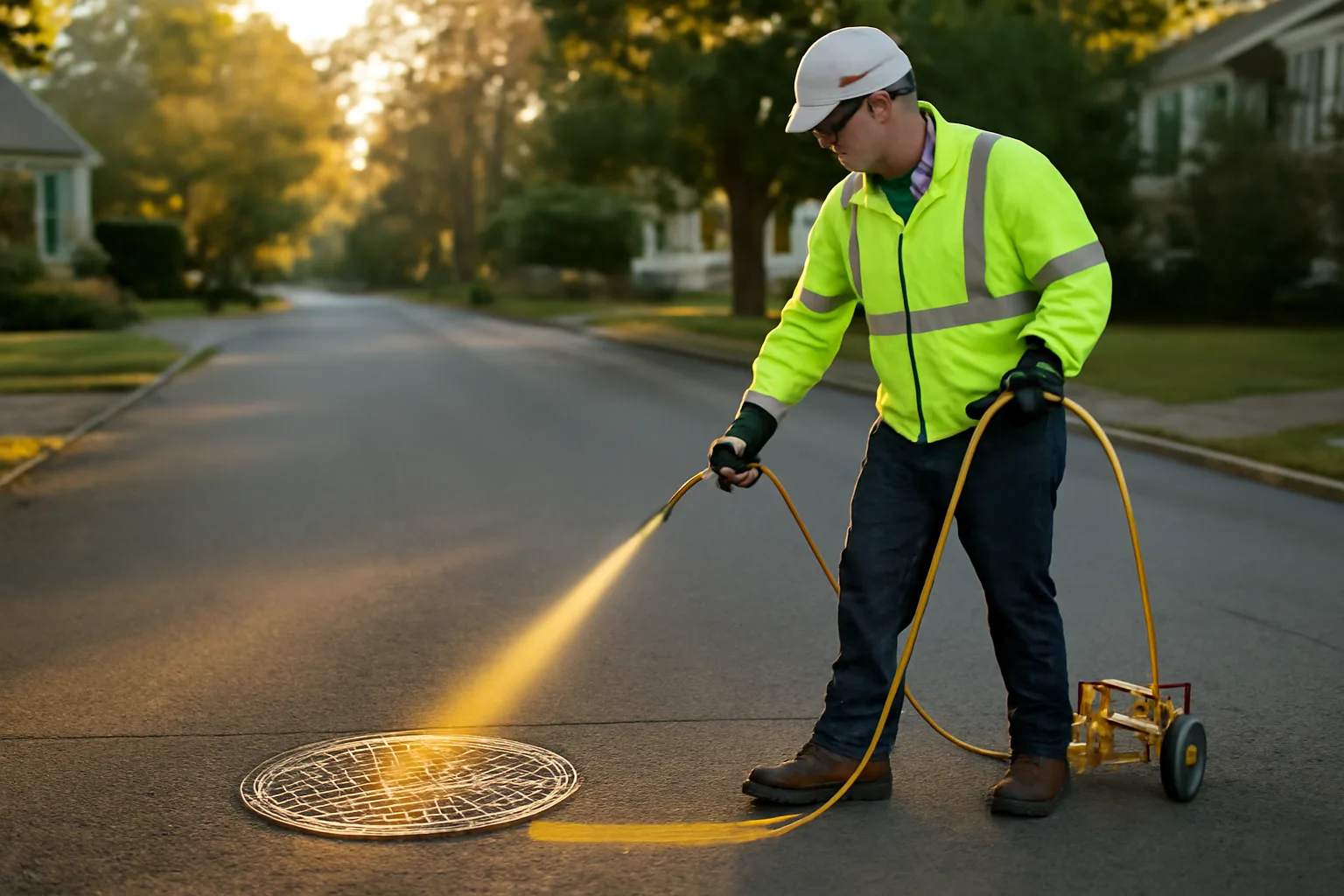
- Use the APWA Uniform Color Code. Yellow for gas and oil, red for electric, orange for communications, blue for water, green for sewer, white for proposed excavation [6]. Every mark follows this code.
- Mark inside the CBYD window. Once the excavator’s two-working-day wait ends, all affected facility operators must have marked their lines or reported a clear status [3].
Most contractors put you through an in-house program that mixes classroom time and field hours. Some like NULCA (National Utility Locating Contractors Association) certification, which is a voluntary credential [7]. It can help you get hired. The state does not require it, and paying for it before you have a job offer is usually a waste of money.
How Much Does It Cost to Become a Utility Locator in Connecticut?
Zero dollars to the state. Connecticut charges no application fee, no renewal fee, and no exam fee for locators, because there is no license to buy. Every dollar you spend goes to training and gear.
Starting cold, you will usually need a high school diploma or GED and a valid driver’s license. Training is the biggest line item, and here is the good news: plenty of locating employers pay you to learn on the job and cover all the cost. Others want you to show up knowing the basics. That is where self-study earns its keep.
LocatorPath’s 811 Locator Career Kit is $129 one-time. It covers the fundamentals a typical pre-employment test checks: reading prints, running electromagnetic equipment, the color code, and the 811 process. One purchase, not a subscription, built for people with zero experience.
Beyond that, budget $50 to $150 for safety boots and high-visibility clothing if your employer does not supply them. Many do. The financial barrier here is low. Gear costs swing hard by region, and utility locator cost Alaska shows how expensive equipment gets in remote areas. Connecticut is far cheaper to break into.
How Long Does It Take to Start Working as a Utility Locator?
It comes down to the employer’s training cycle. A company posting a trainee spot might hire you within two weeks of applying. Then you spend 2 to 6 weeks in training before you locate solo. That stretch covers classroom time on state rules, hands-on equipment practice, and days shadowing an experienced locator.
Know the basics already? The process moves faster. Locators moving in from other states sometimes start within a week, because there is no state license to transfer and no board to wait on. The only holdup is the employer’s internal sign-off.
Aim for a contract locating firm that wants NULCA certification and you add another 2 to 4 weeks plus the exam fee, roughly $200 and not always reimbursed. That path is the exception, not the rule.
How Connecticut’s Call Before You Dig System Works for Locators
CBYD sets the rhythm of a locator’s day. Excavators file a locate request at least two full working days before they dig [3]. CBYD routes the ticket to every utility member with facilities in the dig area. Your job is plain: pull the ticket, get to the site, mark the lines inside the window.
Marks follow the APWA color code. You work with paint and flags. A single site with several utilities can carry red, yellow, orange, and blue all at once. The one-call ticket has a unique number, and you will cite it if a dispute ever comes up.
When a facility operator misses the deadline, the excavator can follow up with CBYD. Repeated misses can bring PURA citations [4]. The locator does not pay that fine, the facility operator does. But your performance review will notice. Blowing ticket deadlines is a fast way to lose a contract.
Penalties for Non-Compliance and Damage
Connecticut hits hard on damage. Under the Call Before You Dig statute, a person who violates the requirements faces a civil penalty of up to $2,500 for each violation [2]. When the violation causes injury or property damage, the exposure grows, and there is liability for repair costs on top of the fine.
For a locator, the risk is usually professional, not personal. The employer carries the insurance and eats the fine. But if you mark a line wrong and a backhoe rips through it, your job is on the line. Gross negligence can reach an individual, though that is rare.
The statute is built around the one-call duty: excavators must notify CBYD and obtain the names of the facility operators before disturbing any underground facility [1]. If you are the locator and a dig goes bad because you never marked, your employer is the one out of compliance. The penalty flows uphill to the operator.
Getting Hired as a Utility Locator in Connecticut
Three kinds of employers hire locators in Connecticut: public utilities (Eversource, United Illuminating, Avangrid), private locating firms (USIC, ELM, Stake Center, and regional outfits), and municipalities that run their own water or electric departments.
Utility jobs tend to pay more and come with benefits, and they are harder to land. Private firms hire in waves, heaviest during construction season from late spring through early fall. Entry pay runs about $18 to $24 an hour, with overtime common.
Employers want a clean driving record, the stamina to work outdoors year-round, and some mechanical sense. A background in construction, landscaping, or even delivery driving helps. If you are new, showing up with self-study done, like the LocatorPath kit finished, sets you apart from applicants who did nothing. For how hiring works in a tougher market, our look at the utility locator board in Florida shows a training credential counts for more where competition is stiffer.
How Connecticut Compares to Neighboring States
Connecticut is not alone in skipping locator licensure. Most of New England runs the same way. Here is a quick comparison:
| State | Individual Locator License? | Oversight Body | One-Call Wait |
|---|---|---|---|
| Connecticut | None | PURA via CBYD | 2 working days |
| Massachusetts | None | Department of Public Utilities, Dig Safe | 72 hours |
| Rhode Island | None | R.I. Public Utilities Commission, Dig Safe | 72 hours |
| New York | None (contractor registration required) | Dept. of Public Service, Dig Safely New York | 2 working days |
None of these states licenses the individual locator. New York requires excavation companies to register, but not the locator on the crew [9]. Massachusetts also has no individual locator license and works through its Dig Safe one-call center [8]. So if you live in Springfield and think about working across the line in Connecticut, the rules are nearly the same.
Want more states? See our guides on the utility locator board in Alabama and the utility locator board in Arizona. A few states, Hawaii among them, layer on extra requirements. In the Northeast, it runs on the honor system and employer training.
Frequently Asked Questions About Utility Locating in Connecticut
Q: Do I need a license to be a utility locator in Connecticut? A: No. Connecticut does not issue a license for individual utility locators. You need a job with a facility operator or contractor, plus proper training. No state card.
Q: How much does it cost to become a utility locator in Connecticut? A: The state charges nothing. Your only costs are training materials and safety gear. Self-study runs from free to a few hundred dollars. Many employers cover training entirely.
Q: How long does it take to get hired as a locator in Connecticut? A: Hiring often takes 1 to 2 weeks, then 2 to 6 weeks of employer training before you work solo. With prior experience, you could start in under a week.
Q: Is there a utility locator board in Connecticut? A: No. No board licenses or regulates locators here. PURA oversees damage prevention, not individual workers. You get hired by a facility operator or a locating contractor, then work under their training and the CBYD ticket system. That is the whole paper path in Connecticut.
Q: What is CBYD? A: CBYD stands for Call Before You Dig. It is the state one-call center that excavators contact before digging. CBYD notifies facility operators, who then send locators to mark lines.
Q: What are the penalties for hitting a line? A: Civil penalties reach $2,500 per violation, plus liability for repair costs and damages. The employer usually pays the fine, but negligence can cost you your job.
Q: Do I need a certification to be a utility locator? A: The state does not require one. Some employers prefer NULCA certification, which is voluntary and involves an exam. It can improve your odds of getting hired, but it is not mandatory.
Q: Who enforces locator rules in Connecticut? A: PURA enforces the Call Before You Dig law. It investigates damage incidents, issues fines, and pushes facility operators to follow marking rules. Locators are not licensed or fined as individuals in the usual case. The operator that employs you takes the civil penalty, up to $2,500 per violation under state statute.
Q: Can I be self-employed as a locator? A: Yes, but you would contract directly with facility operators or excavators, carry your own liability insurance, and follow CBYD procedures. There is no state-issued license for an independent locator.
Q: What experience do I need? A: The law requires none. Most employers want a driver’s license, a clean record, and basic mechanical skills. Construction, landscaping, or utility work backgrounds all help.
Q: Is there a test to become a locator? A: No state test. Some employers run their own written and field tests. Voluntary certifications like NULCA have a written exam. Expect a pre-employment screen on color codes, the CBYD window, and basic electromagnetic locating if you apply at a private firm. Pass that and you still train on the job before marking solo.
Q: Do I need insurance as a locator? A: As an employee, your employer covers liability insurance. Independent locators should carry general liability and errors and omissions coverage. There is no state locator license that checks insurance, so coverage is a contract and hiring issue, not a board filing. Utility and municipal jobs handle it through the company policy.
Q: Are there any age restrictions? A: No state age set for locators specifically, but you must be 18 to enter most job sites and to operate a company vehicle. A valid driver’s license is the real gate.
Frequently asked questions
Do I need a license to be a utility locator in Connecticut?
No. Connecticut does not issue a license for individual utility locators. You need a job with a facility operator or contractor, plus proper training. No state card.
How much does it cost to become a utility locator in Connecticut?
The state charges nothing. Your only costs are training materials and safety gear. Self-study runs from free to a few hundred dollars. Many employers cover training entirely.
How long does it take to get hired as a locator in Connecticut?
Hiring often takes 1 to 2 weeks, then 2 to 6 weeks of employer training before you work solo. With prior experience, you could start in under a week.
Is there a utility locator board in Connecticut?
No. No board licenses or regulates locators here. PURA oversees damage prevention, not individual workers. You get hired by a facility operator or a locating contractor, then work under their training and the CBYD ticket system. That is the whole paper path in Connecticut.
What is CBYD?
CBYD stands for Call Before You Dig. It is the state one-call center that excavators contact before digging. CBYD notifies facility operators, who then send locators to mark lines.
What are the penalties for hitting a line?
Civil penalties reach $2,500 per violation, plus liability for repair costs and damages. The employer usually pays the fine, but negligence can cost you your job.
Do I need a certification to be a utility locator?
The state does not require one. Some employers prefer NULCA certification, which is voluntary and involves an exam. It can improve your odds of getting hired, but it is not mandatory.
Who enforces locator rules in Connecticut?
PURA enforces the Call Before You Dig law. It investigates damage incidents, issues fines, and pushes facility operators to follow marking rules. Locators are not licensed or fined as individuals in the usual case. The operator that employs you takes the civil penalty, up to $2,500 per violation under state statute.
Can I be self-employed as a locator?
Yes, but you would contract directly with facility operators or excavators, carry your own liability insurance, and follow CBYD procedures. There is no state-issued license for an independent locator.
What experience do I need?
The law requires none. Most employers want a driver’s license, a clean record, and basic mechanical skills. Construction, landscaping, or utility work backgrounds all help.
Is there a test to become a locator?
No state test. Some employers run their own written and field tests. Voluntary certifications like NULCA have a written exam. Expect a pre-employment screen on color codes, the CBYD window, and basic electromagnetic locating if you apply at a private firm. Pass that and you still train on the job before marking solo.
Do I need insurance as a locator?
As an employee, your employer covers liability insurance. Independent locators should carry general liability and errors and omissions coverage. There is no state locator license that checks insurance, so coverage is a contract and hiring issue, not a board filing. Utility and municipal jobs handle it through the company policy.
Sources
- Connecticut General Statutes Chapter 293 (Excavation for or Location of Public Service Facilities): Defines facility operator and excavator and establishes the duty to notify CBYD before digging.
- Connecticut General Statutes § 16-347: Sets a maximum civil penalty of $2,500 per violation for non-compliance with call before you dig requirements.
- Connecticut General Statutes § 16-346: Requires excavators to provide advance notice and facility operators to mark facilities within the statutory window.
- PURA Damage Prevention Program: PURA is the enforcement authority for Connecticut's underground damage prevention laws, including CBYD compliance.
- Call Before You Dig (CBYD) of Connecticut: CBYD is the mandated one-call center; excavators must provide advance notice before digging.
- APWA Uniform Color Code: Standard marking colors: red for electric, yellow for gas, orange for comms, blue for water, green for sewer.
- NULCA (National Utility Locating Contractors Association): NULCA certification is a voluntary credential for utility locators; not required by Connecticut state law.
- Massachusetts Dig Safe Law: Massachusetts also has no individual locator license and runs its one-call system through Dig Safe.
- Dig Safely New York: New York requires contractor registration for excavation, not individual locator licensing.
- OSHA 29 CFR 1926.651: Employers must ensure a competent person is trained in excavation safety, including locating underground utilities.