Last updated 2026-08-18
TL;DR
California has no board that licenses individual utility locators. The California Underground Facilities Safe Excavation Board (UFSB, the Dig Safe Board) enforces damage prevention laws and can fine up to $50,000 per violation [1]. If your work includes any digging, like potholing, you need a contractor license from the Contractors State License Board (CSLB) [2]. Pure marking needs no state license.
what is the utility locator board in california?
There isn’t one. People searching for a “utility locator board” want the state agency that licenses locators, and in California that agency doesn’t exist. Two separate bodies shape the rules for anyone who locates, marks, or digs near underground lines.
The first is the California Underground Facilities Safe Excavation Board (UFSB). Created under Government Code section 4216.21, the UFSB runs the state excavation safety program, issues citations, and assesses civil penalties for damage prevention violations [1]. Its members come from utilities, excavators, local government, and the public.
The second is the Contractors State License Board (CSLB), which licenses contractors who excavate, build, or improve property. If your locating service digs, even to expose a line for depth checks, you almost certainly need a CSLB license in a qualifying classification like C-61/D-64 (Underground Utility Construction) or C-34 (Pipeline and Underground Utility Construction) [3]. The CSLB doesn’t issue a “utility locator” license. It issues a contractor license for the work you actually do.
So there is no single utility locator board in California. The UFSB enforces the rules. The CSLB controls who can legally dig.
do you need a license for utility locator in california?
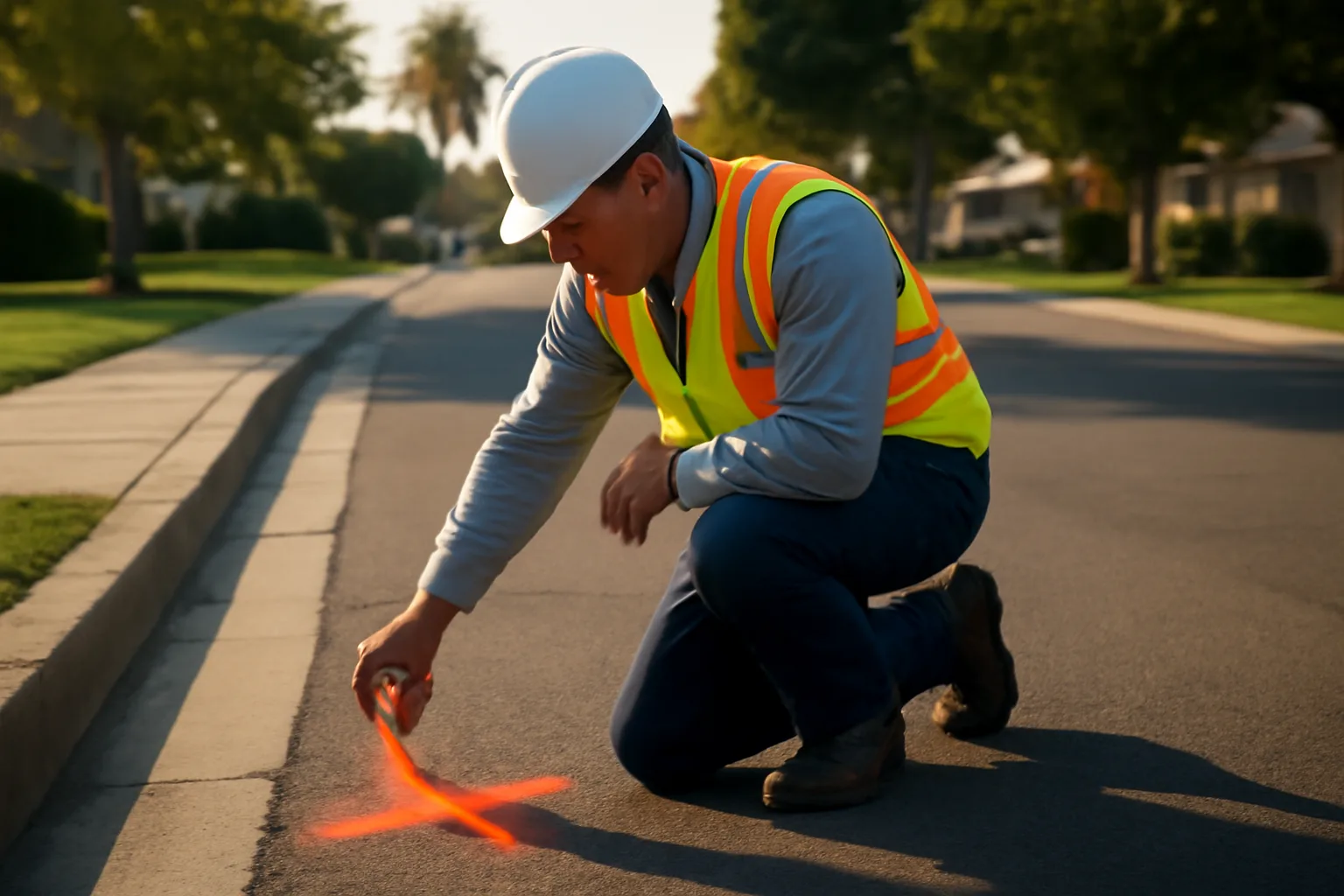
Not for locating and marking alone. California law does not require a state-issued license to paint marks that show where underground utilities run. Responding to an 811 ticket and marking lines sits outside the CSLB definition of contracting, as long as no excavation happens [4].
Everything changes when a shovel or vacuum excavator shows up. If you dig, scrape, probe, trench, or pothole to verify a line’s depth or type, you are an “excavator” under Government Code section 4216(e) [5]. That triggers two hard requirements:
1. You must hold a CSLB contractor license for the excavation work. 2. You must follow the 811 notification process before any digging begins (at least two working days’ notice, not counting the day of notification) [6].
Many private locating firms in California carry a C-61/D-64 license for exactly this reason. Run a CSLB license lookup and you’ll see “C61 - D64” on businesses that offer locating with potholing. A solo locator who only marks and never digs lives in a gray zone. The safest reading of the law is that marking-only work is unlicensed. But any customer who buys both locating and digging from one company will expect a valid CSLB number on the invoice.
how much does utility locator cost in california?
The question splits two ways: what it costs to get set up as a licensed locator, and what it costs when you mess up. Start with setup.
A solo locator who never digs has a regulatory cost of zero. No board license. The real money goes to training and equipment.
Add excavation to your scope and the CSLB license becomes a real line item. As of 2024, the CSLB application fee is $450 [7]. You also need a $15,000 contractor’s bond, which usually runs $150 to $300 per year depending on your credit. There’s an initial license fee of $200 after you pass the exams, plus exam fees of $125 each for the Law and Business test and the trade test [7]. First-year regulatory cost lands around $900 to $1,050.
That’s paper only. You still need insurance, a truck, and locating gear. Plenty of locators start out employed by an existing firm and let the employer carry the license. Go independent and the CSLB reviews your trade exam results and verifies four years of journey-level experience before issuing anything [8].
The penalty side is a separate world. The UFSB can hit an unmarked dig or a locator error with a civil penalty up to $50,000 per violation [1]. Real fines usually land well below that ceiling, and the board’s own annual reports track penalties assessed year over year [10]. Aggregate data before 2022 is thin, so treat any single “average fine” number with caution.
how long does utility locator take in california?
It depends on what you’re after. Marking as an employee takes weeks. A CSLB contractor license takes months.
If you just want to start marking lines on a payroll, get hired, finish in-house training, and you’re in the field. No state licensing clock runs at all.
If you’re chasing your own CSLB contractor license because you plan to dig, budget three to six months from application to license in hand. The rough breakdown, based on current CSLB processing and licensee reports:
- Application review: 4 to 6 weeks after the CSLB receives your complete package.
- Exam scheduling: another 2 to 4 weeks. You sit the Law and Business exam plus the trade exam that matches your classification (often C-61/D-64).
- License posting: 1 to 2 weeks after the board gets your passing score and initial license fee.
That’s the clean path. A detailed application review or a failed exam adds roughly two months. The CSLB doesn’t spring surprises: it wants verifiable experience, no outstanding tax liens, and a clean bond. Bank on four months as a realistic median. Six months is not rare. [4][8]
california 811 requirements every locator must know
The 811 process runs the whole trade, and California law is specific. Before any excavation, even a hand-dug test hole, the excavator must contact the regional notification center (USA North 811) at least two working days before starting, not counting the day of notification [6].
That ticket tells utility owners to mark their lines. As a locator answering a ticket, you are the hands doing the marking. The law doesn’t make you hold a license to mark, but it does require accurate marks that meet UFSB standards. Mark wrong, someone hits a line, and the board can investigate and cite.
Here’s where people get confused. The excavator who pulls the ticket carries the legal duty to dig safely. The locator who marks the lines isn’t automatically on the hook for a strike unless negligence shows up, say failing to mark at all or ignoring an obvious field signal. Even so, the UFSB can cite excavators and locators alike under the “any person” reach of section 4216.21 [1].
One practical fact worth memorizing: a California 811 ticket is valid for 28 days from the legal start date. Mark past that window and the marks count as expired. That means a fresh ticket and another two-working-day wait, unless an emergency exception applies.
california vs. states with a standalone utility locator board
California splits the job in two: UFSB for enforcement, CSLB for contracting. That’s different from states with a dedicated locator licensing board. If you’ve read about the utility locator board in alabama or the utility locator board in arizona, you know those states issue a specific locator license. California does not.
A few comparators:
- Alabama charges a $300 annual locator license fee and requires a written exam. No such exam exists in California for locating alone.
- Florida offers a private locator registration through the Dept. of Financial Services for $125. California has no parallel.
- Colorado and Illinois fold locator training under their 811 laws, often through an approved class.
- Hawaii leans on a Public Utilities Commission damage prevention program.
California’s model means fewer hoops to start marking and more scrutiny once you cross into excavation. Getting licensed as a California contractor is harder than passing a standalone locator exam in another state. Weigh that if you’re thinking about a move or work across state lines.
cslb license classifications that matter for utility locators
Not every contractor license fits locating. The CSLB keeps several dozen classifications, and two turn up most in this trade.
- C-61 / D-64 (Underground Utility Construction). D-64 is a subcategory of the C-61 Limited Specialty classification. It covers installing, repairing, and connecting underground utilities plus the excavation to do that work [3]. A company that locates and potholes regularly usually holds this one.
- C-34 (Pipeline and Underground Utility Construction). This one allows major pipeline work and includes excavation. It’s overkill for a small locating shop but common for firms bidding municipal contracts.
If you only locate and mark, no classification on the CSLB list fits you. That gap is deliberate. The CSLB has historically treated marking alone as outside contracting because it does not improve, alter, or construct property [4]. Painting orange arrows on asphalt is not construction.
Add vacuum excavation to your menu later and you’ll need the license. A license also clears a common jobsite rule: many general contractors require every subcontractor on site to carry a CSLB license, scope aside. For a lot of independent locators, a C-61/D-64 is a business call, not strictly a legal one for marking-only work.
fines, penalties, and what happens when a utility line is hit
The UFSB has teeth. Section 4216.21 of the Government Code lets the board assess "a civil penalty in an amount not to exceed fifty thousand dollars ($50,000) for each separate violation" [1]. Penalties climb when a violation causes property damage, injury, or death.
The process is plain. After a damage report reaches the UFSB, an investigator contacts the parties, pulls 811 ticket records and field photos, and issues a proposed citation. The cited party can request an informal hearing or appeal to an administrative law judge. Most cases settle with a reduced penalty and required fixes, like re-training crews.
Many citations trace back to basic failures: no 811 ticket, digging past the ticket window, or ignoring visible markings. A locator who marks a line wrong can get tagged as an “excavator” if the board decides the bad marks led straight to the damage. Marking-only locators rarely draw UFSB citations unless the evidence points to gross negligence, but it happens.
The math is simple. A fine can outrun the cost of a training program many times over. LocatorPath’s 811 Locator Career Kit ($129 one-time) covers the fundamentals that keep you off those enforcement logs. It isn’t a contractor license, but it’s the ground-floor knowledge that stops a paint mistake from turning into a five-figure penalty.
how to start a career as a utility locator in california
No “locator board” sets the path, so entry looks like any skilled trade. Most people get hired by a damage prevention company or a utility, train on the job, and move up.
Step one: learn 811. Before you even apply, know the ticket lifecycle and the color code. Grab the skills however works for you: free online material, the 811 center’s guides, or structured self-study like the LocatorPath kit, so you can talk the language in the interview.
Step two: land a position. California employers often want a clean driving record, the ability to pass a drug test, and a high school diploma. They supply the equipment and the hands-on training.
Step three (going solo): decide whether your service will ever include excavation. If yes, start the CSLB contractor application. Gather four years of verifiable experience, as an employee or through a qualified apprentice program [8]. If you’ve worked for a licensed contractor, the qualifier can sign off on your experience form.
Step four: study for the trade exam. CSLB study guides are free. A D-64 exam covers shoring, soil classification, and more. It’s a construction test, not a locating test.
No step here charges a “utility locator board” fee or asks for board approval. California puts the burden on the contractor license if you dig, and on your employer’s internal standards if you don’t. That’s a different setup from the utility locator board arkansas or utility locator board delaware models, where a state board certifies locators directly.
training and certifications that matter in california
The state mandates no locator certification, so a third-party credential is worth exactly what your employer or your customers say it is. Many California locating firms ask for NULCA (National Utility Locating Contractors Association) certification or completion of an OSHA 10-hour construction safety course.
NULCA’s Certified Utility Locator program requires a written exam and documented field hours. It’s not a government license, but it can mean a dollar more per hour and often tips a bid on a sensitive contract. The test covers mark-out procedures, damage prevention, and site safety. No law requires it. The market sometimes does.
The 811 center’s own materials and the UFSB’s damage prevention guidance are free and authoritative. Master that guidance, pair it with hands-on training inside a company, and you build credibility fast. A low-cost supplemental course like the career kit helps the concepts stick, but nothing beats field time.
One nuance people skip: California is a strong union state in many regions. Some utilities employ union locators under local labor agreements. If you want in, the union may require training beyond any state minimum. Check with IBEW or Laborers’ locals near you.
will california ever create a dedicated locator license board?
The idea comes up every few years, usually right after a headline gas line strike. Legislators have filed bills to tighten excavation rules, but no proposal to build a stand-alone locator licensing board has gained traction. The current UFSB structure is young. It was reformed in 2017 under AB 1135, and the board has leaned toward stronger enforcement rather than a new licensing layer [9].
The politics are simple. A new license means a new bureaucracy, exam development, and funding, most likely through fees charged to locators. The construction lobby tends to fight new licenses unless a major disaster forces the legislature’s hand. For now, California lets you locate without a board stamp.
None of this is fixed. The UFSB’s annual report tracks near-misses and damage trends [10]. If those numbers climb hard, so will the pressure for a license. Watch the board’s reporting if you’re building a career here.
Frequently asked questions
do you need a license to mark utility lines in california?
No. Marking lines without any excavation does not require a contractor license from the CSLB or any other state board. Once you dig to verify a line, though, a CSLB contractor license is required and the 811 notification process applies.
what is the california underground facilities safe excavation board?
It’s the state agency that enforces excavation damage prevention laws. The UFSB investigates incidents, issues citations, and can fine violators up to $50,000 per violation under Government Code section 4216.21. It does not issue, license, or certify individual locators.
how do i get a utility locator certification in california?
The state offers no locator certification. Many locators pursue NULCA certification or OSHA safety cards on their own. These credentials are market-driven, not legally required, and their value depends on what employers and customers ask for.
what is the 811 notification timeline in california?
You must contact USA North 811 at least two working days before any excavation begins, not counting the day of notification. The ticket stays valid for 28 days from the legal start date. Mark or dig past that window and you need a fresh ticket.
can a private locator get a cslb license without digging?
Possibly, but the CSLB licenses by classification, and marking-only work generally falls outside the definition of contracting. Many solo locators operate with no license for marking. Some still get a C-61/D-64 for credibility and jobsite access, since it covers the digging they may add later.
what is the penalty for hitting a gas line in california?
The UFSB can assess a civil penalty up to $50,000 per violation. The final amount depends on negligence, damage severity, and prior violations. A willful violation or one causing serious injury can also lead to criminal charges beyond the civil penalty.
how much does a cslb contractor license for utility locating cost?
The application fee is $450. You’ll also need a $15,000 bond (roughly $150 to $300 per year), an initial license fee of $200, and exam fees of $125 each for the Law and Business and trade tests. First-year regulatory cost runs about $900 to $1,050.
how long does it take to get a cslb license for utility work?
Realistically, 3 to 6 months. The CSLB reviews complete applications in 4 to 6 weeks, exam scheduling adds 2 to 4 weeks, and the license posts 1 to 2 weeks after you pass and pay the initial fee. Plan on four months when everything goes smoothly.
does california require a locator to be certified by the state?
No. There is no state certification for utility locators. The UFSB enforces damage prevention laws but does not certify, license, or register individual locators. Any certification you hold comes from a private body like NULCA, not the state.
where can i check a utility locator’s license in california?
You can check a contractor license on the CSLB website if the locator performs excavation work. For marking-only locators, there is no state license to check, because California issues no locator license at all.
what insurance do utility locators need in california?
General liability insurance is strongly recommended and often required by clients. The CSLB bond protects the state’s interest, not third-party claims, so it isn’t a substitute. A typical locator carries a $1 million general liability policy.
is there a utility locator board exam in california?
No. California has no state-wide locator exam. The CSLB trade exam for contractor classifications covers construction topics, not utility locating. Marking-only locators never sit a board exam, and the UFSB does not test or certify locators.
Sources
- California Government Code § 4216.21: UFSB can assess civil penalty up to $50,000 per violation, and any person may be cited.
- Contractors State License Board, Apply for a License: Excavation work requires a CSLB contractor license.
- CSLB Classification List, C-61 / D-64: D-64 covers underground utility construction and excavation.
- California Government Code § 4216(e): "Excavator" defined to include anyone who digs.
- California Government Code § 4216.2: 811 notification required at least two working days before excavation, excluding day of notification.
- CSLB, License and Fee Schedule: Original application fee is $450, exam fee $125 each.
- CSLB, Experience Requirements: Four years of journey-level experience needed for a contractor license.
- AB 1135 (2017), Dig Safe Act reforms: Reorganized UFSB enforcement structure without adding a locator license.